|
 |
|
| City &
Highlight Sightseeing ::
Shiraz ::
Highlights |
|
|
|
|
 |
|
Where to Eat & Drink
in Shiraz
Restaurants & Teahouses
Always try a new local cuisines , you never
forget it. |
|
|
|
Vital Information
Money , Getting
around, internet, Health, Post, Visa,
Safety...etc
A few things to know before getting there |
|
|
|
|
|
|
SHIRAZ SPECIALS: |
|
|
|
 |
 |
 |
| |
|
|
|
Historical Monuments
Palaces and Edifices
Castles and Citadels
Historical Bridges and Caravansaries
Ancient Cities and Archaeological Hills
Inscriptions and Engravings
Fire Temples
Tombs
Old Schools
Old Bazaars
Old Public Baths and Water Reservoirs
Historical Caves
Other Historical Monuments
Palaces and
Edifices
Abunasr Palace (Takht-e-Abunasr), Shiraz
Six
kilometers east of
Shiraz, on top of a hill, is a relic
of an edifice made of brick and stone.
As a result of archeological
excavations, these remains have been
estimated to date back to the Parthian
period but it was also used in the
Sassanid period. Probably in the
pre-Islamic era Takhat-e-Soleiman or the
palace of Abunasr was located where the
present city of Shiraz is toDay. This
palace has been registered in the list
of National Heritage monuments.
Back to top
Achaemenid Royal Palace, Sarvan Village
Opposite
the Saravan Village, there are ruins
relevant to the Achaemenian Dynasty. The
90 cm. base pillars with the same
ornamental engravings of the
Takht-e-Jamshid pillars, are
scattered around the ruins. The
mentioned monuments are the remainders
of the Achaemenian Kingdom Palace.
Back to top
Ardeshir-e-Babakan Palace, Marvdasht
This
rather large monument is made of stone
and has three domes with many rooms. The
ornaments and carvings on top of the
interior doorways are similar to those
in
Takht-e-Jamshid. This palace has
been registered on the list of National
Historical Sites.
Back to top
Baq-e-Eilkhani Edifice, Shiraz
It dates
back to the time of Mohammad Qoli-Khan,
a leader of the Qashqei tribe. The
garden in which it is located (about
6,000 sq.m.) dates back to the Qajar
period.
Back to top
Baq-e-Nazar Pavilion, Shiraz
A
pavilion that is located in Baq Nazar, a
beautiful garden with tall and ancient
trees, dates back to the Karim Khan
period. There is a charming pavilion
built by Karim Khan, known as Kolah
Farangi. The ceramic work on the
exterior of this building is quite
unique. There are paintings by well
known artists of the Zand period on the
walls.
Back to top
Mirror Palace (Dokhtar Palace), Rastaq
Village, Darab
This
palace is situated 8 km. from the Rastaq
Village. Placed in a deep valley, it is
surrounded by mountains from the three
sides. To the west of the palace is a
rim of mountains which have a special
luster, in such a way that the image of
every thing can be seen on it. The
antiquity of the palace belongs to the
3rd century A.D.
Back to top
Pasargadae, Marvdasht
This
palace is 600 meters to the northeast of
the
Koorosh (Cyrus) Shrine. The area of
this palace is 2,620 square meters and
includes a large hall (with eight
columns) in the middle and four terraces
in four directions and two rooms in the
corners. To the east of the palace is
Pasargadae, composed of a large hall
with eight columns. There is a doorway
on the north, east and western side of
this hall. In the northern doorway,
there is an impression of a winged human
with two wings directed towards the sky
and two wings to the bottom, whereas the
hands are raised towards the sky in a
gesture of prayer.
This edifice with 3,427 square meters
area is located 15 km. northwest of the
palace. The main hall has 30 columns
made of white stone. A mass of black and
white stones have been used as
construction material. One of the
characteristics of Pasargadae is the
canals made of white stone, which were
used, for irrigation.
There are equally other remains
distributed in the province, some
registered as national heritage
monuments. These include the ruins of
the Achaemenian Dynasty (Saravan
Village), the Dokhtar Palace (Rastaq
Village) dating back to the 3rd century
A.D., the restored Sassanid Palace (Sarvestan)
dating originally back to the time of
Bahram Gour (year 420 A.D.),
Ardeshir Babakan Palace (Marvdasht).
Back to top
Persepolis,
Marvdasht
On top of
the rocky mountain of Rahmat in the
plain of
Marvdasht, the ruins of
Takht-e-Jamshid palace are pre-eminent.
Construction of these palaces started at
the time of Darius I (521 B.C.) and was
not completed in less than a period of
150 years. Takht-e-Jamshid is registered
as a World Heritage Site by UNESCO.
The entrance of the complex is formed by
a two-ramp stairway composed of 110
rather wide and short steps. On top of
the stairways is the main entrance or
The Great Gate, marked by two statues
of a bull with a human head and a pair
of wings. There are two exits, one to
the south and the other to the east. The
south exit or gate connects to the
Apadana Palace.
Takht-e-Jamshid is 125 thousand sq.m. in
area, and is composed of the main
sections:
 Official
reception halls and palaces Official
reception halls and palaces
Smaller
and more private palaces
Royal
treasury
Private
fort and special fortification
Various edifices or palaces that have
been built are as follows:
The
Small Palace or the Gate of All Nations
The
Apadana Palace
The
Palace of Darius,(one of the primary
palaces constructed on the
Takht-e-Jamshid rock, which was also
called the "Tachar" Palace.)
Hall
or palace of a Hundred Columns
The
Semi-finished Gate or palace
Treasury
of Takht-e-Jamshid
The
Three Doorway or Consultation Palace or
Hall
The
stone well
Tombs
of Ardeshir II and III
The
Palace of Khashayar Shah (called Hadish)
Takht-e-Jamshid was set ablaze by
Alexander the Greek (330 B.C.) after
which only ruins have remained. From
these ruins, the Apadana Palace, at the
main entrance, with 36 columns and three
balconies (12 columns in each) in the
north, south and eastern sections of the
palace have been remained. The northern
and eastern terraces are connected to
the gardens opposite. The height of the
platform in the Apadana Palace is 16 m.
and the height of its columns is 18 m.
Back to top
|
|
Sassanid Palace, Sarvestan, Shiraz
|
|
Located 9 km southwest of Sarvestan,
it is a large monument made of stone
and gypsum. This monument dates back
to the Sassanid period and to the
time of Bahram-Gour (420-438 A.D.).
Mehrnevsi, his well-known minister
ordered the construction of this
palace. Since 1956, major
renovations took place. This
monument has been registered on the
list of National Monuments of Iran. |
|
Other Ancient Palaces and Edifices,
Fars |
The other
palaces and edifices include the
Kiaros Palace and the Baq Neshat
edifice.
Back to top
|
Castles and Citadels |
|
Charoo Castle, Lar
|
|
It is
considered to be a well-known castle
because of the Esmaili influence
(the followers of Hassan Sabah). It
is 15 km west of the Barm-Shoor Lake
and located on top of the Chero
Mountain. The antiquity of this
castle goes back to 5th century.
Back to top
|
|
Dokhtar Castle, Firooz Abad |
|
Dating back to the 3rd century, this
historical site is found in a
mountainous area overlooking the
Firooz Abad plain. Many tourists
come to visit this site. Tourists
can reach the summit by existing
mounting facilities.
Back to top
|
|
Eizad Khast Castle, Abadeh |
|
The
ruins of this ancient castle are at
a distance of 141 km from Esfahan.
In this castle small houses and
narrow alleys dating back to the
Sassanid period can still be
distinguished. The square building
which in the Sassanid era was
supposed to be a fire temple and
praying quarter was later on, in the
9th century A.H. changed into a
mosque.
Back to top
|
|
Ejdeha Peykar Castle, Lar
|
|
This
castle is built on a hill to the
west of the
Lar Township. The structure is
composed of three sections: The
stone wall, the upper tower and the
middle tower. It dates back to the
pre-Islamic period. Its been
inhabited until the 20th century and
was bombarded at the time of Reza
Shah.
Back to top
|
|
Estakhr
Castle, Marvdasht |
|
The
Estakhr Mountain is to the extremity
of the southwest of the
Marvdasht plains; on top of
which the famous Estakhr Castle was
constructed in the
Azododoleh-ye-Deilami period. In
this place a large pool (Estakhr)
was made, but unfortunately at
present, only a very tall ancient
cypress tree dating back to a
century can be seen among the ruins
of the stony building of the castle.
Back to top
|
|
Kaka Castle, Mamasani
|
|
This
castle is located 8 km. from the
hilly village of Kalgeh and is
surrounded by the Ena and Sejak
Gorges from which the
Fahliyan River crosses by. It is
believed that this castle once
belonged to the Esmailians and its
antiquity dates back to 6th century
A.H. This castle is situated in the
Mamasani Township.
Back to top
|
|
Karim Khani Citadel, Shiraz |
|
It
used to be the main residential
palace of Karim Khan-e-Zand and his
dynasty in
Shiraz. Surrounded by high brick
walls, there are four towers, each
at a corner of the complex. This
place was used as a prison for
thirty five years until 1971.
Although damaged as a result of
misuse, renovations are taking
place. This monument is a good
representative of the architectural
style which was typical of the Zand
period.
Back to top
|
|
Qabr Castle, Jahrom
|
|
This
castle is located 50 km. from
Jahrom city, at the top of a
mount in an altitude of 400 m. To
the west of this castle is a small
spring. Beside the spring there is a
narrow zigzag route, which
terminates to the tower of the Qabr
Castle.
Back to top
|
|
Qadamgah Castle, Lar
|
|
Located northwest of the ancient
city of
Lar, this castle is built on a
platform surrounded by steep slopes.
It dates back to the pre-Islamic
period and was used for defense
purposes. ToDay only ruins (the
northern wall and two smaller
towers) remain as in the Safavid
period, this place was destroyed.
Back to top
|
|
Sefid (White) Castle, Mamasani |
|
This
castle is located 15 km. north of
Noor-Abad, it dates back to the
Ilamite era. It is believed that in
5th century, it was one of the
famous castles of Esmailians and in
the year 654 A.H. it was destroyed
by Holakoo Khan the king of the
Mongols.
Back to top
|
|
Zahak Castle, Fasa
|
|
On
top of a hill near
Fasa, there exists a castle
belonging to the Sassanid period.
Ceramic objects have been found at
this site.
Back to top
|
|
Other Castles and Forts, Fars |
|
The
other historical castles of the
province include: Mohrak and Tabar (Khorsheh)
Castles in
Jahrom, a building known as
grave the of Nader Shah's mother in
Lar, Gahvareh-ye-Deev in
Shiraz, Dimeh Mil of Jahan Ahmad
Shah in Noor Abad, Soleiman Prison
Tower in
Shiraz and Rooy Reneh (Rooineh).
Back to top
|
Historical Bridges and Caravansaries
|
|
Abbasi Bridge, Lar
|
|
This
bridge was built on the east of the
Shoor River during the Safavid
period. It had seven columns,
possibly most of which are still
remain. This bridge has been
basically repaired many times.
Back to top
|
|
Ali-ebne Hamzeh Bridge, Abadeh |
|
This
bridge is located between
Shiraz - Esfahan. It was built
on Khoshk River of Shiraz, in the
Al-e-Boyeh era and has been repaired
for many times. The final repair and
construction works have been
performed in the Karim Khan Zand
period (1185 A.H.).
Back to top
|
|
Band-e-Amir Bridge, Marvdasht |
|
In
the south-east of the
Marvdasht plains, and across the
Korr River, a very fortified dam was
made, the bridge of which is called
Band-e-Amir. This bridge, being an
important monument of the early
centuries of Islam, related to the
Azododoleh-ye-Daylami period.
Back to top
|
|
Sassanid Caravansary, Firooz Abad
|
|
This
caravansary is located at 3 km.
south of the
Sassanid Fire Temple in
Firooz Abad. It probably dates
back to the Sassanid era. It
consists of a large court surrounded
by many rooms. The rooms are made
with the characteristic architecture
of the Sassanid era. They are
blocked on three sideds, and the
other side opens to the court of the
caravansary.
Back to top
|
|
Sassanid Road, Firooz Abad |
|
The
road between
Firooz Abad and Darabgerd was
discovered in 1960 by Professor
Wandenbuerg. Here, some buildings
are seen which belong to the
Sassanid era, e.g., Kerateh and Zaq
Fire Temples. |
|
Other
Historical Bridges, Caravansaries
and Roads, Fars |
|
Other
historical bridges are the
following: Khan Bridge (Marvdasht),
Peerin Bridge (Peerin Valley) and
Abguineh Bridge (Kazeroon).
Back to top
|
Ancient Cities and Archaeological
Hills
Bishapour Ruined City, Kazeroon
This
city was built by Shapour I and
included palaces with a large
fire-temple and inscriptions of the
Pahlavi script. The main palace has
a hall with many corridors and
various verandas and gardens. The
plan of the hall is 20 sided.
Back to top
Ancient City (Takht-e-Tavoos),
Shiraz
Located 7 km. from the remains of
Persepolis (Takht-e-Jamshid),
the ruins of the city of Estakhr
known as Takht-e-Tavoos exists. It
includes a stony gate, columns and
walls dating back to the Achaemenian
period. Many archaeological objects
have been found at this site, which
belong to the Sassanid, Parthian and
Islamic eras.
Back to top
Firooz Abad Ancient City, Firooz
Abad
It is
located to the northwest of the
present city of
Firooz Abad. The remainders of
the old fortification of the city,
stony and brick-made buildings have
covered the area. The remains of the
ancient city of Firooz Abad
constitute one of the most valuable
historical sites of Iran.
Back to top
Hakvan Hill, Kazeroon
It is
one of the archaeological hills of
the
Fars Province, where many pieces
of pre-historic ceramics and remains
of a building dating back to the
Achaemenian period have been found.
This hill is on top of a white rocky
foundation which is 24 m. long and
10 m. wide in size. In this vicinity
a few long spears were discovered
with royal emblems such as a crown
on them.
Back to top
Hassan Qazi Ancient City, Safarbeg
Village
This
city is located 3 km northeast of
the Safar Beig Village. The main
residential areas of the city along
with towers and fortifications still
remain. This city is probably the
same Touj city that was conquered by
Kalam-ebne Abalhesar, Commander of
Omar-ebne Khatab which became the
center of Muslim activities.
Back to top
Marvdasht Archaeological Hills,
Marvdasht
Scientific discoveries and
researches indicate that different
civilizations have been living in
this vast plain. Many imprinted
ceramic vessels along with
implements and tools have remained
from those civilizations. These date
back to 3500 B.C.
Back to top
Takht-e-Soleiman, Marvdasht
Over
the mountain to the north of the
Passargadae plain, there is a
beautiful area with large
stony-white walls, in which many
artifacts have been found. Thus,
witnessing the reality that this
place had been inhabited even before
the Achaemenian period, and was most
probably used as a praying site. The
discovered objects belong to 4000
B.C.
Teimoorian Hill, Kooshk Village,
Shiraz
This
hill is located 1 km. west of the
Kooshak Village in Arsanjan. Since
2500 B.C. up to the Islamic period,
dead bodies used to be buried in
this hill. In some of these graves
many interesting objects such as
ceramic dishes (red or gray in
color) with black patterns as well
as jewelry (i.e. rings, necklaces,
pins) and animal shaped ceramic
statues have been found.
Back to top
Other
Ancient Cities and Archaeological
Hills
Other
ancient cities and archaeological
hills includes: The ancient city of
Cheshmeh-ye-Sardo in Noor Abad,
Qasr-e-Bahram Archaeological Hills
in Dehbid -
Shiraz Road, Rigei and Siyah
Archaeological Hills in Darab,
Hassan Abad Castle and Kamin
Archaeological Hills in Hassan Abad,
Shafa Archaeological Hills 17 km.
from
Persepolis and Jari
archaeological hills at 16 km south
of Persepolis.
Back to top
Inscriptions and Engravings
Ilamite Period Embossed
Inscriptions, Seteloo Village, Lar
In
the Saravan Mountains and on top of
a hill by the river, there exist a
few carvings that belong to the
Ilamite (Ilami) period. The same
shows two symbolic figures: A man
and a woman, each with a pair of
horns on their head. A man is
sitting on a throne, on which a
snake has coiled. He is holding the
head of snake. This man is offering
the water of life to another man
who is sitting next to him.
Three
people are standing to their right
side, and two to their left, with
long robes. A group of 27 people,
with short robes are standing in
front of them observing them
obediently.
Back to top
Korangoon Inscriptions, Noor Abad,
Mamasani
To
the north-west of Fahliyan, and to
the south of the Seteloon Village,
located 20 km. north-west from Noor
Abad, on the top of Korangoon
Mountain, there are engraved
monuments known as "Sagmetro" or "Naqareh
Khaneh" (the place where drums are
beaten at stated intervals in a
shrine). The antiquity of these
monuments dates back to the 3rd
century B.C.
Back to top
Naqsh-e-Rajab
Engraving, North Persepolis,
Marvdasht
To the north of
Persepolis, there are carvings
of Ardeshir Babakan and Shapour I.
This carving consists of three
embossed pictures of Ardeshir
Babakan, Shapour I, as well as the
emblem of his dynasty besides other
great personalities of the Ardeshir
era.
Back to top
Naqsh-e-Rostam Engraving, Haji Abad,
Marvdasht
In
the same direction as the historical
site of
Naghsh-e-Rajab and at the
termination of the Haji-Abad
Mountain, there are many historical
ruins belonging to the Achaemanian,
Ilamite and Sassanid periods. These
sites include: The stone carvings on
the lower slopes (Sassanid), tombs
of the Achaemanian Kings on the top
of the hill and the square-shaped
monument (Zoroastrian inscription)
on the right side. This complex no
doubt is a major tourist attraction
site especially for those interested
in archaeology and history
Details of the carvings are as
follows:
The
impression shows Nerssi (296-304
A.D.), the elder son of Shapour I as
being designated the King by Anahita
(Nahid).
This
carving is located at the lower
portion of the tomb of Darius the
Great and consists of two similar
seats. The upper image shows Bahram
II (277-293 A.D.) fighting the
enemy.
Representing
the conquest of Shapour I (242-271
A.D.) against Valerian the Roman
Emperor. In this carving Shapour I
is sitting on a horse and Valerian
kneeling by the horse. Ceriyadis
(the challenger of Valerian) is
standing in front of the horse, and
the king of Iran with streched
hands, offers him a ring, to rule
east roma country.
This
carving shows the conquest of
Hormozd II, the Sassanid Monarch.
A
picture of Bahram II defeating the
enemy.
This
famous carving is of great
importance. It shows a person who is
standing. To his left, a head and
face can be seen.
A
representation of Ardeshir Babakan
(226-242 A.D.), this carving shows
him being designated as the King by
Ahura Mazda.
Back to top
Naqsh-e-Shapour Engraving, Kazeroon
It
has remained as a part of a thriving
city. The ruins of Shapour exist in
the Chogan Valley, a few kilometers
away from Kazeroon. In the Chogan
Valley, on the precipice of the
mountain and on both sides of a
river, many carvings can be
distinguished:
Two
men on their horses standing face to
face and a third person bending on
his knees stretching his hands as
though begging for forgiveness.
It
seems to be an impression of Shapour
on a horse, with curly hair and a
crown of a monarch. Above Shapour's
head there is an angel with a horn.
On two sides of the carvings, are
two arches, in each of which three
people are carved. It seems that
Shapour is apparently receiving
people with gifts for him.
This
shows Shapour with two armed
soldiers on their horses. One of
them is giving a ring to the other.
Back to top
Other
Inscriptions and Engravings, Fars
The
other carvings and inscriptions of
the province includes:
Naqsh-e-Bahram in Noor Abad,
Naqsh-e-Shapour in
Darab, Tangab Embossments,
Tang-e-Boraq Pahlavi inscription in
Passargadae and Takht-e-Gohar or
Takht-e-Rostam in north
Persepolis.
Back to top
Fire Temples
Achaemenid Fire Temples, Haji Abad,
Kazeroon
At
the vicinity of
Naqsh-e-Rostam, on two sides of
the Haji Abad Mountain, two small
stony towers exist which belong to
the Achaemenian period. On top of
these towers some holes are seen
which were supposed to be the fire
places. On much higher spots of the
mountain, at different altitudes
even more fire holes have been
observed. In the bottom of the rocky
mountain, there were cavities dating
back to the Sassanid era mainly used
for placing bones of the dead.
Back to top
Faraz
Mara Avar Khozaya Fire Temple,
Kazeroon
This
fire temple is situated in the old
Kazeroon -
Firooz Abad Road, and was
constructed by Mehr Nersi in the
Sassanid era.
Back to top
|
| |
|
Firooz Abad Fire Temple, Firooz Abad
|
|
It
was made of well-carved stones on a
large foundation, upon which the
fire temple was situated. On the top
of this structure a dome was placed
overlooking the city. At present
only the tower has been remained.
Back to top
|
|
Jareh
Great Fire Temple, Kazeroon |
|
This
place was the location of one of the
five fire temples which were
constructed by Mehr Nersi in areas
between
Kazeroon and Farash Band. The
length of each side of this fire
temple is more than 14 m. long. The
great Jareh Fire Temple belongs to
the Sassanid era.
Back to top
|
|
Kazeroon Fire Temple, Kazeroon |
|
This
fire temple is situated at 10 km.
south-east of
Kazeroon. At present, from these
monuments, except for three stands
and two semi-ruined domes, nothing
is left. This structure was
constructed by Mehr Nersi.
Back to top
|
|
Pasargadae Fire Temple, Marvdasht
|
|
At
the distance of 1500 m. away from
the Exclusive
Palace of Koorosh, on the
eastern plains of Morqab, two bits
of white rocks, opposite a short
hill at a distance of 9 m. from each
other, are located. They are called
Pasargadaes Qorbangah (Altar)
or fire temple.
Back to top
|
|
Sassanid Grand Fire Temple, Firooz
Abad |
|
At
the distance of 30 km. south of
Firooz Abad, there are the ruins
of a monument which probably used to
be the greatest aggregate of
fire-temples of the Sassanid era.
The exterior wall is 85 m. long and
40 m. wide. Inside the
fortification, where the
fire-temples and residences of
Zoroastrian priests, along with
under ground pathways that can still
be observed.
Back to top
|
|
Other
Fire Temples, Fars |
|
Other
fire temples of the province
includes: The Azarakhsh and Azarjoo
Fire Temples in
Darab, Kenar Siyah Fire Temples
in
Firooz Abad, Qadamgah Fire
Temples in
Jahrom, Ab-Bakhshan fire holes
in the
Naqsh-e-Rostam Mountain, Kariyan
Fire Temple, Samikan Fire Temple in
Shiraz and Farash Band Fire
Temple in Firooz Abad.
Back to top
|
|
Tombs
|
|
Goor-e-Dokhtar Tomb, Kazeroon |
|
Dating back to the Achaemenian
period, the Goor Dokhtar Tomb is
located in the Jereh Village. This
historical monument is composed of a
rectangular room with a gable roof
standing on a platform with three
steps. The presence of segregated
sections at the top and bottom of
the Goor Dokhtar construction, was
for placing dead bodies, indicates a
dual burial system.
Back to top
|
|
Hafiz
Tomb, Shiraz |
|
Hafiz
is one of the most famous Gnostics
and poets of Iran, who was born in
Shiraz in 726 A.H. and passed
away 65 years later. The tomb of
Hafiz also known as Hafizieh is
located north of Shiraz and
comprises of two gardens. Many
people still come to pay homage to
this master of poetry. The mausoleum
itself is located in a lovely
garden, and has an atmosphere of
peace and calm that is quite unique.
Back to top
|
|
Jamasb Grave, Koradeh Village,
Jahrom |
|
Located close to the Karadeh
Village, at the distance of less
than 2 km., on the top of a
comparatively low mountain, a
cubical stony platform exists. Each
side of this cube is 5.5 m. wide and
6 m. high. This stony platform is
known as Jamasb Tomb.
Back to top
|
|
Khajoo-e-Kermani Tomb, Shiraz |
|
The
tomb of Kamal-edin Abu Ata known as
Khajoo (689-756 A.H.) is located in
the
Allah Akbar Gorge close to the
Qoran Gate of
Shiraz. It is the tomb of a
famous Iranian poet and Gnostic.
This memorial was completely
renovated in recent years.
Back to top
|
|
Koorosh Kabir (Great Cyrus) Shrine,
Shiraz-Esfahan Rd. |
|
On
the
Shiraz - Esfahan Road and in the
Morqab plains, this rectangular
monument is built on a six-storey
platform. On the top floor, which is
3 m. high, there are two tombs, one
belonging to Koorosh, and the other
to his wife Kassandan mother of
Kamboujieh. These two graves are
interconnected by a meter long and
35 cm. wide corridor.
Back to top
|
|
Sa'di
Tomb, Shiraz |
|
Sa'di,
a keen traveler and famous Gnostic,
was a known poet of the 7th century
A.H. he was born in
Shiraz and passed away between
the years 695-691 A.H. In 1942, the
present building was constructed by
the Association for National Arts
and the tomb of Sa'di was placed in
an octagonal mausoleum with high
dome and interesting tile works.
Back to top
|
|
Shah
Shoja' Mozafari Tomb, Shiraz |
|
In
Takht-e-Zarabi and to the west of
Tekiyeh-ye-Haft Tanan, the tomb
of the most reputed monarch of the
Mozafar Dynasty, i.e., Abolfovares
Shah Shoja' son of Amir Mobarezedin
exists. In 1971 a memorial was
constructed on his grave which is of
special value from architectural and
historical point of view.
Back to top
|
|
Sheikh Kabir (Ebne Hanif) Tomb,
Shiraz |
|
Abu
Abdollah Sheikh Mohammad Ben Hanif,
known as Sheikh Kabir was one of the
greatest gnostics and Sheikhs of
Shiraz. At present the tomb
stone of the Sheikh is located
behind the
Vakil Bazaar, in a room
furnished by tiles. In the Atabakan
period, Atabak Zangi Ben Modood,
repaired this tomb and later on it
was renewed again.
Back to top
|
|
Sheikh Roozbehan Tomb, Shiraz |
|
This
building which is a tomb of one of
the known Iranian Gnostics is
located in the east
Shiraz. At present only a small
part of this tomb has remained and
the tombs of the Sheikh along with
those of his sons and grand children
are located within the area. In 1967
a new structure was constructed on
these graves.
Back to top
|
|
Sibveyh Tomb, Shiraz |
|
Abu
Bashar Amrobne Osman known as
Sibveyh was one of the most famous
scientist of the time. He is the
author of the book "Alketab". His
tomb is located in Sang-e-Siyah to
the north of
Kazeroon Gate of
Shiraz. Recently an interesting
structure has been constructed on
his tomb.
Back to top
|
|
Other
Tombs, Fars |
|
Other
historical tombs of province
include: Shah Da'ie Ala Allah
mausoleum, Sheikh Mohammad Lahiji
mausoleum, Seyed Mir Mohammad
mausoleum, Sheikh Aqta' mausoleum,
Seyed Tajedin Qarib mausoleum in
Shiraz, Imamzadeh Bareiz in
Lar, Sheikh Moniredin shrine in
Mamasani.
Back to top
|
Old Schools
|
|
Aqa
Baba Khan School, Shiraz |
|
Dating back to the Qajar period, it
is near the
Vakil Bazaar and Jame Mosque.
The same belongs to the Karim Khan
Zand period. The construction of
building was begun by haji Mohammad
Hossein Khan and finally in 1862,
the construction was completed by
Aqa Baba Khan Hossein.
Back to top
|
|
Khan
School, Shiraz |
|
This
historical monument is situated in
Shiraz city. This building was
constructed by Allah Verdi Khan and
his son in the Shah Abbas period.
This place, which used to be a
theological school, has been
restored several times.
Back to top
|
Old Bazaars
|
|
Moshir Arcade, Shiraz |
|
Golshan or Moshir Caravansary is
located near
Vakil Bazaar, which is relic of
Mirza Abol Hassan Moshir-ol-Molk.
This arcade was repaired in 1970.
Its rooms have been used as an
exhibition hall for the
demonstration of local handicrafts
of
Fars, thus called "Sarayeh Honar"
(Art House).
Back to top
|
|
Qeisariyeh Bazaar, Lar |
|
This
bazaar which is located in the old
city of
Lar, was built during the reign
of Shah Abbas Safavid. It has been
registered on the list of National
Cultural Heritage sites of Iran. The
building was once repaired in 1310
A.H. by Fathali Khan Garashi and has
been restored recently by National
Cultural Heritage Organization.
Back to top
|
|
Vakil
Bazaar, Shiraz |
|
This
bazaar is located in
Darb-e-Shahzadeh (Gate of Prince),
near the
Vakil Mosque. It has five
entrances with two rows of shops (Hojreh),
situated north-south and east-west
direction and perpendicular to each
other. It displays a beautiful
architecture with wide corridors and
high ceilings along with openings
which allow air circulation and
penetration of light.
Back to top
|
|
Other
Old Bazaars, Fars |
|
Bazaar-e-Nov of
Shiraz is also considered as one
of the oldest bazaars of
Fars Province, which was
constructed in the late Qajar era.
Back to top
|
Old Public Baths and Water
Reservoirs |
|
Afif Abad Bath, Shiraz
|
|
It is
situated to the north of the
Afif Abad Garden, museum or
edifice. The interior walls have
been ornamented with characteristic
plaster works and painting of men
and women of the Qajar period.
Back to top
|
|
Baq-e-Neshat Bath, Shiraz
|
|
This
bath located to the north of
Baq-e-Neshat Garden, is composed of
two rooms each with a small dome.
One of the domes is erected on
pillars with intricate spirals which
open out to the garden. The
paintings on the walls are quite
refined and delicate.
Back to top
|
|
Seyed Ja'fari Water Reservoir, Lar
|
|
This
reservoir which has an interesting
dome is one of the oldest water
reservoirs in
Lar. The diameter of the dome is
14 m. with a height of 10 m. The
water level reaches 20 m. and it is
distributed through a system of
channels, which was built in the
Safavid period.
Back to top
|
|
Vakil Bath, Shiraz
|
|
It is
located near the
Vakil Mosque. Due to change in
the conditions of public baths, it
has lost its original shape. The
Vakil Bath is a monument of the Zand
period.
Back to top
|
Historical
Caves |
|
Sheikh Ali Cave, Haji Abad, Kazeroon
|
|
At
the distance of 5 km. east of
Naqsh-e-Rostam and along the
ruins of Estakhr, there is a cave in
which inscriptions in Pahlavi script
are written. These are in
commemoration of nine monuments
built by the order of Shapour I and
contemplate his ability in handling
arms. There is very narrow path by
the cave that leads to the tomb of
Sheikh Ali, a Gnostic.
Back to top
|
|
Tang-e-Chowgan Cave, Kazeroon |
|
In
the Chowgan Valley there is a rather
large cave in which a huge statue of
Shapour I has been carved. The
length of cave entrance is about 16
m., with a height of less than 8 m.
The height of statue is 7 m. high
and its shoulders are 2 m. wide, and
its hands are 3 m. long. It is said
that in addition to this giant
statue of Shapour I, the tomb of
this great man is also situated in
this cave most probably.
Back to top
|
Other Historical Monuments |
|
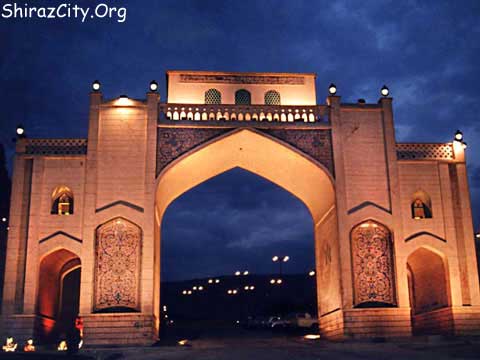
Darvazeh Qoran (Qoran Gate), Shiraz
|
|
At
the entrance of the
Shiraz city and in the
Allaho Akbar Gorge, about 1000
years ago a gate was built on top of
which Karim Khan Zand consequently
built a small room containing a
Qoran. In 1938 due to road
developments the old monument was
destroyed. About ten years later the
gate was restored and ever since it
is known as the Qoran Gate.
Back to top
|
|
Other Historical Monuments, Fars
|
|
Other
historical monuments of the province
include: The Emarat Building in
Rostam Village in
Mamasani, Divan Khaneh edifice
in Shiraz and Dahan Shir in
Lar.
Back to top
|
|
|
|
|
|
|
 |
 |
 |
|
|
|
|
| |
|
|
Religious
Monuments |
Old Mosques
Mausoleums and Imamzadehs
Old Churches
|
Old Mosques |
|
Atiq Jame' Mosque, Shiraz
|
|
This
mosque was built in celebration of
the conquest of
Shiraz by Saffarid Amroleiss in
the year 276 A.H. and was completed
in 281 A.H. It has been restored
many times. The height of the
building and its various nocturnal
areas (Shabestans) with beautiful
tile work on the ceilings, gives a
unique charm to this place.
Back to top
|
|
Nasirol Molk Mosque, Shiraz |
|
This
mosque is situated at the end of the
Lotfali Khan-e-Zand Street. Nasirol
Molk, who was one of the elites of
Shiraz, is the founder of this
mosque. This mosque is unique for
its tile work and architecture. The
construction work of mosque began in
1293 A.H. and was finally terminated
in 1305 A.H., by Mohammad Hassan
Me'mar and Mohammad Reza Kashi Paz
Shirazi.
Back to top
|
|
Noe (Shohada) Mosque, Shiraz |
|
In
the old times it was called the
Atabak Mosque. Its construction work
began in 598 A.H. by Atabak
Sa'd-ebne-Zangi and was completed in
615 A.H. This very large mosque has
a ceiling that is 40 m. high and 25
m. wide supported by 12 lower
sections. Its building has been
recently restored.
Back to top
|
|
Vakil Mosque,
Shiraz |
|
It is
one of the most valuable monuments
dating back to Zandieh period. Its
construction was completed in 1773
A.D. The said premise with an area
of 3600 Sq.m. has been furnished
with large stones. Its nocturnal
area or Shabestan (night prayer
hall) with an area of 2700 sq.m.
contains 48 similar tall pillars of
stone with a beautiful ceiling and a
marble altar that is considered to
be one of the master pieces of the
Zandieh era.
Back to top
|
|
Other Old Mosques, Fars
|
|
Other
old mosques of the province include:
The
Nayreez Jame' Mosque,
Darab Jame' and the Sangi
Mosque.
Back to top
|
Mausoleums and Imamzadehs |
|
Abesh Khatoon Mausoleum, Shiraz
|
|
In
Shiraz, near the Qasab Khaneh
Gate there is a semi-ruined
structure known as "Abesh Khatoon".
Abesh Khatoon was the queen of the
last king of the Atabakan of Fars,
i.e., Menko Teimoorqa Aan, the 11th
son of Holakoo Khan Mongol. The
inscriptions of this building belong
to the Safavid era. This place is
registered as a National Heritage
Site.
Back to top
|
|
Bibi Dokhtaran Mausoleum, Shiraz
|
|
This
square building is situated in Sebaq,
Shiraz. The dome is placed at
the center of structure. It is said
that Om-e-Abdollah is buried there.
This placed is registered as a
National Heritage Site.
Back to top
|
|
Chehel Tanan Mausoleum, Shiraz |
|
At
the south of Haft Tanan Blvd. and to
the east of
Jahan Nama Garden, the Chehel
Tanan Mourning Place exists, related
to the Karim Khan Zand period. In
this place 40 tomb stones can be
observed. These belong to 40
Gnostics.
Back to top
|
|
Haft Tanan Mourning Place, Shiraz |
|
Karim
Khan Zand built a beautiful edifice
in a garden at the foot of the
Chehel Maqam Mountain. There are
seven tombs in this place that is
for which the present name stands
for, meaning Seven Bodies.
Back to top
|
|
Imamzadeh Shah Hamzeh, Kazeroon
|
|
This
tomb is located in
Kazeroon Bazaar. It is said that
the tomb is of Hamzebne Mosabne
Jafar. This Imamzadeh is one of the
most respected pilgrimage sites for
the inhabitants of Kazeroon.
Back to top
|
|
Imamzadeh Shah Mir Ali Hamzeh,
Shiraz |
|
This
Imamzadeh is located near the
Qoran Gate of
Shiraz. It is known that the
original structure is of the
Azododoleh-ye-Daylami period and was
repaired and reconstructed in
Teimoorian, Safavid, Zandieh and
Qajar eras.
Back to top
|
|
Imamzadeh Shahzadeh Ala-edin,
Mamasani |
|
This
Tomb is located 2k m. from Noor
Abad, in the
Kazeroon - Khuzestan Road. It is
a part of a complex, and comprises
of two Imamzadehs. The Imamzadeh
opposite to it because of having an
iron door is known as "Darb-e-Ahanin".
Imamzadeh Ala Edin with a high dome
was constructed in 1025 A.H, at the
time of Shah Abbas the Great.
Back to top
|
|
Seyed Ala-edin Hossein Shrine,
Shiraz |
|
This
pilgrimage site which is located in
the south-east of
Shiraz is the shrine of
Shah Cheraq's brother. The main
construction, with tile work
adornments belong to the Safavid
era.
Back to top
|
|
Shah
Cheraq Mausoleum, Shiraz |
|
A
place of pilgrimage but also worth
visiting for its unbelievable mirror
work, it contains the tomb of the
brother of Imam Reza (P.B.U.H.) who
died in the 8th century. The first
construction of it is attributed to
Atabak Sa'ad Ebn-e-Zangi. In the 8th
century A.H. it was repaired and
developed by the mother of Ishaq
Injoo. In the early 10th century
A.H., it was again repaired. But
late in the century, an earthquake
ruined it so it underwent renovation
once more. In the year 1243 A.H.,
during the reign of Fathali Shah
Qajar, some sections were added to
it. In the year 1958 its dome was
reconstructed. This shrine is one of
the most famed places of pilgrimage
for the followers of the Shiite sect
in Iran and in the world.
Back to top
|
|
Other Mausoleums and Imamzadehs,
Fars |
|
Other
mausoleums and Imamzadehs of
province include: Shah Da'ie Ala
Allah Mausoleum, Sheikh Mohammad
Lahiji Mausoleum, Seyed Mir Mohammad
Mausoleum, Sheikh Aqta' Mausoleum,
Seyed Tajedin Qarib Mausoleum in
Shiraz, Imamzadeh Bareiz in
Lar.
Back to top
|
Old Churches |
|
Christian Church, Shiraz
|
|
This
church is situated in the Armenian
sector of Sarjooy. The main hall and
paintings with plaster work and
ornaments date back to the Safavid
period.
Back to top
|
|
The Vasari
Corridor Tour -
From $93.00
(Florence)
High above the streets of Florence and
its famous bridge, the Ponte Vecchio,
sits the Vasari Corridor. Now you can
reserve a guided tour through this
historically exclusive passage. A
guided tour of the Galleria degli Uffizi
is also included.
Details >> |
|
|
|
|
|
|
|
|
|
|
|
| |
|
|
Museums
Tribal Areas and Special Villages
Handicrafts, Music, and Foods |
Museums |
|
Afif Abad Military Museum, Shiraz
|
|
The
Golshan garden, also known as
Afif Abad Garden has a beautiful
building that was converted to a
museum in 1988. This museum has a
collection of military artifacts in
the ground floor and on first floor
there are beautiful reception halls
and rooms decorated with paintings,
which are worth seeing.
Back to top
|
|
Narenjestan Museum, Shiraz |
|
Built
in 1881, this magnificent building
located in a beautiful citrus garden
which dates back to the Qajar
period. It was restored in 1967.
This museum contains some of the
objects which date back to 3000
years ago. Furthermore, its
photographic and slide archives on
ancient monuments of Iran is
considered to be one of the best in
the country.
Back to top
|
|
Natural History and Technology
Museum, Shiraz |
|
This
museum is a new double storied
building which consists of two
sections. The natural history
section was inaugurated in 1974 and
the technology section was
inaugurated in 1986. by the
Shiraz University.
Back to top
|
|
Pars Museum, Shiraz
|
|
The
Kolah Farangi pavilion located in
the midst of the Nazar Garden in
Shiraz, was converted to a
museum in 1852 and was restored in
1901. In this museum eleven
paintings by Aqa Sadeq, a well known
artist of that time, is on display.
The building is composed of a
central hall with a dome and four
alcoves. In the eastern side, Karim
Khan Zand was originally buried.
Valuable objects can also be seen in
this museum.
Back to top
|
|
Persepolis Museum, Marvdasht |
|
It is
situated in the Khashayar Shahs
Harem. It was inaugurated in 1938
under the name of
Takht-e-Jamshid (Persepolis). In
this museum objects from the
pre-historic, Achaemenian and
Islamic periods are all collected in
three different sections and are on
exhibit.
Back to top
|
|
Shah Cheraq Museum, Shiraz |
|
Inaugurated in 1966 in the main
court of Shah Cheragh, this museum
has many valuable Qorans and
calligraphy as well as ancient
objects.
Back to top
|
|
Shohada Museum, Shiraz
|
|
The
museum building consists of two
stories. In ground floor, there is a
permanent exhibition museum which
consists of paintings and
calligraphy of contemporary artists
and poets and shohadas (martyrs). In
the first floor there is a temporary
exhibition museum which consists of
paintings and calligraphy of art
students.
Back to top
|
Tribal Areas and Special Villages |
|
Tribal
Area,Fars |
|
The
Fars Province is a home to many
tribes that comprise of about 10
thousand families in total. These
tribes are the Qashqaie, Khamseh,
Boyer-Ahmadi and
Mamasani. The life styles of
these tribes have always attracted
tourists to Iran. The summer
residing quarters (cooler regions)
where Qashqaie tribes move to
frequently in summer is in the
extreme northern sections of the
Kamfirooz region, extending from
Tavileh Band and Garmeh to Brujen.
The Khamseh tribes make use of the
lands to the east of this area, from
Marvdasht to
Bovanat. On the other hand, in
winter, the Qashqaies migrate to the
southern parts of the province, as
their winter residing quarter, such
as,
Firooz Abad, Maymand, Bushgan,
etc. At the same time, the Khamsehs
occupy vast areas in the east and
southeast of the province including
Fasa,
Jahrom,
Darab and
Lar.
The Mohammad Abad Village (in
Eqleed), Dozdkar Village(in
Sepeedan), Bardaneh Village(in
Darab) and other villages such
as Khosrow-va-Shirin, Qotb Abad and
Qalat subdivision have charming
rural settings surrounded by
interesting plants and watersheds or
springs.
Back to top
|
Handicrafts, Music, and Foods |
|
Handicrafts and Souvenirs, Fars
|
|
Gelim,
coarse carpet, rug, carpet and hand
made woven products with colorful
designs well representing the tribal
aspects of the
Fars Province. The most famous
handicraft of the
Shiraz is Khatam (inlaid work).
Other handicrafts are felt carpet,
local shoes, leather and wooden
products, local pastries, and other
handicrafts.
Back to top
|
|
Local and Regional Foods, Fars |
|
In
different cities, villages and
tribal areas of the province,
special kinds of food are prepared.
These are known as various Aash
(vegetable Shorba) such as
Shalqam,Anar, Meat Aash, Yogurt,
Kashk, Yasorak, Reshteh, Macaroni,
Spinach, Qooreh, Kardeh, Dooq and
Kaleh Pacheh Aashes; different
Abgoosht(meat Shorbas) such as
cabbage, Macaroni, Adasi and simple
Abgoosht. Other dishes consists of
Polow Babooneh, Havij Polow, Koofteh
Helew, Dampokht, Meigoo Polow, Kalam
Polow Shirazi, various Khoreshts or
curries, Boranies and so many
varieties which would be quite
interesting and fun for new comers
to taste.
Back to top
|
|
Local Music and Dances, Fars |
|
Music
and dances of the Fars province
whether it is rural/tribal or
traditional music are composed of
pleasant sounds and happy songs. The
Stick dance and Helli are some
of tribal dances in the province.
Back to top
|
|
Chapel
- From $18.00
()
Take advantage of PersiaTours
special combination package.
Details >> |
|
|
|
|
|
|
|
|
|
|
|
| |
|
|
Lakes and Wetlands
Altitudes and Gorges
Protected Zones
Gardens and Recreation Places
Rivers
Springs
Waterfalls
|
Lakes and
Wetlands |
|
Arjan Lake and Wetland, Shiraz |
|
Covering about 2000 hectares in
area, it is located 60 km south of
Shiraz at the vicinity to
Shiraz - Bushehr Road. The
recreational Arjan Lake due to its
proximity to historical sites such
as the Bishapour and Shapour Cave
and its accessibility through
communication roads between
Khuzestan and Bushehr provinces with
Shiraz, it is one of the major site
attraction for domestic and
international tourists. Because of
its unique ecological
characteristics, UNESCO has
registered it as a Biosphere
Reserve.
Back to top
|
|
Kaftar Lake (Shadkam Lake), Eqleed
|
|
With
an area of about 48 sq. km., it is
located at southeast of
Eqleed. This lake is considered
as a valuable habitat for migratory
birds with a beautiful and memorable
landscape.
Back to top
|
|
Maharloo Lake, Shiraz
|
|
This
lake with an area of 600 sq.km. is
located 27 km. southeast of
Shiraz. The lake water is used
for extraction of normal salt. It is
considered a suitable and valuable
habitat for migratory birds and wild
animals.
Back to top
|
|
Parishan (Famoor)
Lake, Kazeroon |
|
This
lake is formed 3 km. away from Ayaz
Abad Village and at a distance of 12
km to the southeast of
Kazeroon. It is protected by
Department of The Environment. The
maximum observed water area is 18
sq.km., with an average water depth
of 1.6 m. The lake is used for fish
cultivation. Because of its
ecological value, this lake has been
registered as a wetland of
International Importance (Ramsar
Convention). Especially in spring
and autumn the landscape is
magnificent with interesting
vegetation and wildlife. Many
migratory birds use this wetland as
their wintering habitat.
Back to top
|
|
Tashak
and Bakhtegan Lake, Nayreez
|
|
These
lakes are situated northwest of
Nayreez. The mountainous areas
among them, along with various
islands especially in Tasht Lake
(Pelicans and Nargess islands), have
created a precious natural
aggregate. This region is a home and
suitable habitat to many resident
and migratory birds (e.g. bustard,
owls, etc.). This wetland is a
potential eco-tourism destination in
Fars province.
Back to top
|
Altitudes
and Gorges |
|
The
mountains of the
Province of Fars mostly with a
southeast-northwest slope are part
of the Zagross Mountain Chain. The
highest summit in Fars is 3,943 m. (Sefid
Kooh) and it is situated in the
northeast of the province. Some
other summits, which could be more
or less attractive for professional
hikers, are the following:
Kooh-e-Gar (3,109 m.),
Kooh-e-Toudaj (3,150 m.), and
Kharman Kooh (3,183 m.).
Back to top
|
|
Allah
Akbar Gorge, Shiraz |
|
Basically this gorge should be
called the gateway of the
Shiraz plain, because it gives a
marvelous bird's eye view of the
plains and Shiraz city from this
point. It is said that any new comer
to Shiraz tends to admire the
landscape of the city, seen from
this view point, unconsciously
expresses his wonder by saying
Allah-o-Akbar which means "God is
the Greatest".
Back to top
|
|
Boraq Gorge,
Boraq Village, Sepeedan |
|
It is
located to the north of the Boraq
Village in the Kamfirooz region,
approximately opposite the Margoon
Waterfall. This is a quiet,
beautiful, deep valley with rocky
mountains and a blind end. The
upstream waters crossing a plain
join together to form a beautiful
waterfall. On the left rim of rocky
gorge, an interesting cave has been
created, from the ceiling of which,
water drops like rainfall.
Back to top
|
|
Bostanak (Lost Heaven) Gorge,
Sepeedan |
|
The
magnificent Bostanak Gorge is
located at an altitude of 1,740 m.
above sea level near the North West
vicinity of the Kamfirooz plains.
This gorge is situated at the
watersheds of the Doroodzan. Its
proximity to the Doroodzan Dam Lake
along with the cold and beautiful
regions of the "Ganbil Gorge", "Margoon
Waterfall", "Boraq
Gorge, "Shesh
Peer Spring" and "Ranj" and "Baram
Firooz" Peaks, is considered to be a
recreational region for citizens as
well as a major tourist of
attraction site.
Back to top
|
|
Bovan Gorge, Shiraz
|
|
This
gorge is situated at 8 km east of
the
Shiraz - Ahvaz Road and along
the Noor Abad-Doshman Ziari Road.
During the year beautiful waterfalls
flow from the rocky mountains
surrounding the valley. With an
average temperature of about 20 C,
it constitutes as one of the major
tourist attractions of the province.
Back to top
|
|
Gar Mountain,
Marvdasht |
|
This
mountain is located to the north of
the
Marvdasht Township with an
altitude of 3,109 meters. Its
general direction is right in the
general direction of the Zagross
Mountains, and extends from the
northwest to the southeast.
Back to top
|
|
Layzangan Gorge, Darab
|
|
To
the east of
Darab, there is a forest covered
by gardens of roses, which is known
as Layzangan. This valley containing
sufficient water, verdant gardens
along with beautiful natural
landscapes is considered to be one
of the places worth seeing besides
being a recreational region of the
Darab Township.
Back to top
|
|
Khani Gorge, Shiraz
|
|
Located 29 kilometers from
Shiraz at the vicinity of
Darengoon Village and near the Qara
Aqaj River, this gorge (valley)
annually attracts many people
specially those interested in
mountaineering.
Back to top
|
|
Kharman Kooh Mountain, Fasa
|
Located in
the north of Fasa, this summit is
the highest point of the region with
a height of 3,183 meters.
Back to top
|
|
Palangan Gorge, Nayreez
|
|
At a
distance of 21 km far from
Nayreez is a verdant area called
the Palangan Gorge, which is
considered to be one of the most
important recreational sites of the
region. This gorge is covered by
various fig, pomegranate, willow and
cypress trees along with several
springs.
Back to top
|
|
Sefid
Kooh Mountain, Eqleed |
|
This
mountain, right in the general
direction of Zagross Mountains,
extends from northwest to southeast
and has an altitude of 3,943 meters.
It is the highest summit of
Eqleed.
Back to top
|
|
Todaj
Mountain, Darab |
|
This
snow-clad mountain begins from the
Karam Gorge and extends both
northwest and southeast. The
altitude of its highest summit is
3,150 meters, located to the
northeast of
Darab.
Back to top
|
|
Other Altitudes and Gorges, Fars |
|
Other
gorges and summits of the province
are: Herayerz Gorge close to a
village with the same name, Eaje
Gorge close to Eaje Villege, Laay
Tarik and Estahban Gorges in
Estahban, Zitashtak Gorge in
Nayreez; Jazin (Gazin) Gorge in
Tashtak Village, Kherqeh Valley in
Firooz Abad, and Koohgar Summit
in
Marvdasht.
Back to top
|
Protected
Zones |
|
Bamoo National Garden, Shiraz |
|
With
an area of 48,075 ha, it is located
to the north of
Shiraz. The climate is dry and
warm (Mediterranean). This national
park has many species of flora and
fauna that are internationally
known.
Back to top
|
|
Basiran Hunting Prohibited Zone,
Abadeh |
Situated 4
km. south of
Abadeh, it has many unique
species of plants and animals.
Back to top
|
|
Lar Protected Zone, Larestan |
|
Situated at the common limits
between the
Fars and Hormozgan provinces, it
has an area of 151,284 ha.
Particularly attractive to
researchers and tourists, it has its
own characteristic wildlife, which
are adaptive to hot-dry regions.
Back to top
|
|
Toot-e-Siyah Hunting Prohibited
Zone, Bovanat Region |
Located at
the end of
Bovanat, it is about 20 thousand
km. and has a variety of flora and
fauna.
Back to top
|
Gardens and Recreation Places
|
|
Ab Band Recreation Site, Darab |
|
Located in the Ab Band region, on
the bank of the river and in the
foot hills of the
Darab Mount, this promenade
annually attracts many people due to
its natural beauty and eye-catching
landscapes.
Back to top
|
|
Atashkadeh Recreation Site, Fasa |
|
It is
located on the outskirts of the
Kharman Kooh. There is a spring
and a beautiful pond that is used
for aquaculture purposes.
Back to top
|
|
Baram Delak Recreation Site, Shiraz |
|
This
promenade is located14 km north of
Shiraz. The Baram Delak Wetland
is four km away from the Abunasr
Palace. Its antiquity dates back to
the Sassanid period. A mountain
overlooks the wetland and the stone
carvings that can be found on this
mountain date back to the Sassanid
period.
Back to top
|
|
Chehel Tan Garden, Shiraz |
|
Located in
Shiraz, it was originally used
as a graveyard. This garden was
developed in the Zand period.
Back to top
|
|
Chelehgah Recreation Site, Sepeedan |
|
Located 10 kilometers from
Sepeedan in the Chelehgah
Village, this recreational area
annually attracts many people for
winter sports and mountaineering.
Back to top
|
|
Delgosha Garden, Shiraz |
|
Situated near the
Sa'di Tomb in
Shiraz, this garden dates back
to the pre-Islamic period and the
time of the Sassanids. With an area
of 7.5 ha, it is a major attraction
of Shiraz.
Back to top
|
|
Dimeh Mil Recreation Site, Mamasani |
|
This
promenade is located 7 kilometers
from the Noor Abad Tower
(Fire-Temple) with wonderful
orchards, gardens and several
springs. The area is full of various
flowers with an eye-catching
landscape.
Back to top
|
|
Eram Garden, Shiraz |
|
With
its beautiful flowers and decorative
plants as well as its amazing
edifice, it is now also known as the
Botanical Garden of Shiraz
University, and is in the heart of
the city of
Shiraz.
Back to top
|
|
Golshan Garden (Afif Abad Garden),
Shiraz |
|
Located in
Shiraz, it has an area of 127
thousand Sq.m. The two-storey
building has been constructed at the
request of Mohammed Khan
Qavamol-Molk about two hundred years
ago. The baths, ceramic work and tea
house are well worth seeing. At
present this building belongs to the
Defense Ministry and a museum of
arms has been established in this
structure.
Back to top
|
|
Haft Baram Recreation Site, Shiraz |
|
Located 55 km west of Shiraz, more
specifically 12 km away from
Shiraz -
Kazeroon Road, this promenade
has beautiful landscapes. In winter
it is cold and dry and in summer
mild and pleasant.
Back to top
|
|
Jahan Nama
Garden, Shiraz |
|
This
garden dates back to the Zand period
and is located near the main
entrance to the city of
Shiraz (Darvazeh
Qoran). Within the garden there
is an old building worth visiting.
Back to top
|
|
Mian Kotal Recreation Site, Shiraz |
|
At a
distance of 18 km from Arjan,
situated on the old
Shiraz -
Kazeroon Road, the northern
slopes of this promenade overlooks
the habitat of the rare, unique and
the globally known Follow Deer. Oak
forests used to dominate this region
in the past. In the southern
sections a beautiful landscape of
the Baram Forest can be seen. Higher
altitudes surrounding the beautiful
Mian Kotal Valley particularly
attract those interested in winter
sports. In general the valley has a
mild climate and in different
seasons it is taken advantage of by
nature lovers.
Back to top
|
|
Park-e-Jangali Recreation Site,
Estahban |
|
This
park is located on the outskirts of
Todaj Mount, to the south of
Estahban. There is a spring that
ultimately creates a wonderful
waterfall.
Back to top
|
|
Takht Garden, Shiraz |
|
It is
located in north
Shiraz in the lower slopes of
Baba-Koohi Mountain. At the time of
Aqa Mohammad Khan Qajar, a new
building was built and was
consequently called the Qajars
Takht (Throne). At present this
garden belongs to the army.
Back to top
|
|
Tang-e-Tizab Recreation Site,
Sepeedan |
|
Located 20 kilometers northwest of
Sepeedan in the vicinity of the
Beshar River with diverse species of
endemic fishes, this promenade has
suitable forests with pleasant
weather in summer.
Back to top
|
|
Other Gardens and Recreation Places,
Fars |
|
There
are many other promenades, which are
mostly used by local people and
especially in summer, people tend to
use these cooler places on holiday
and weekends as a resort. Each
vicinity has its own charm and
beauty, with possibilities of
fishing and other sports.
Back to top
|
Rivers
|
|
Aqaj River, Shiraz
|
|
This
river originates from the Tabesk
Mount in the Doshman Ziari Village.
After passing through a valley in
northwest of
Shiraz, it leaves the
Mamasani region at the vicinity
of Chehel Cheshmeh. The Aqaj River
after crossing many farms enters the
Persian Gulf via the Roodmand in the
Bushehr Province.
Back to top
|
|
Fahliyan
River, Mamasani |
|
This
river is formed by the adjoining of
the "Shesh Peer" and "Rood Peer"
Rivers and after passing the Qaleh
Sefid Mount, enters the Fahlian
Plain. This river irrigates a vast
area of the region crosses a deep
valley called the "Tang-e-Abjan" and
in a region named Bardangan, joins
the Katikoor River. It finally flows
to south and creates the natural
border between
Mamasani and Gachsaran.The
course of this river is one of the
most attractive landscapes of the
region and its banks are used as
recreational areas.
Back to top
|
|
Korr River,
Eqleed |
|
The
Korr River originates from the
mountains of Seyed Mohammad and
Palangeri in the
Eqleed Township. After receiving
several water springs, under the
name of the Dezdkor River it finally
enters
Marvdasht via the Tang-e-Boraq
region. Another branch of the Korr
River called the Margan River, after
receiving a salty branch from
Kharestan called Gavgodar, joins the
Dezdkor River and passing through
the Doroudzan Dam finally enters the
Ramjerd plains.
Back to top
|
|
Margan River, Sepeedan
|
|
Originating from the Ranj Mountains
in
Sepeedan, this river is one of
the branches of the
Korr River. After joining with
few branches near the city of
Sepeedan, it forms the Korr River
again. The waterfall of this river
is one of the most famous ones in
Iran and the world.
Back to top
|
|
Shadkam River, Eqleed
|
|
The
river which was known as Saryatan
River in the past, originates from a
spring with the same name which is
placed in Mount Almalicheh. After
irrigating the Namadan plains, it
joins the Kaftar River. The Shadkam
River flows in the vicinity to the
Eqleed Township and its river
banks, and is considered as a
valuable tourist attraction site.
Back to top
|
|
Shoor River,
Lar |
|
This
river is formed by the joining of
some streams, which originate from
the mountains of Siah, Malektir and
Jam. The Shoor River leaves the
Lar Township after absorbing the
water of Lar and Ali Abad plains and
receiving a few other springs.
Back to top
|
|
Other Rivers, Fars
|
|
Other
rivers of the province are: Tangshiv,
Roodsheer and Pirab Rivers in
Mamasani, Shesh Peer and
Choubkhaleh Rivers in
Sepeedan, Qara Aqaj River in
Marvdasht, Bashar River in
Ardakan, Sivand and Shoor Rivers in
Jahrom and Mehran Shoor River.
Back to top
|
Springs |
|
Balangan (Haji Abad) Mineral Water
Spring, Eqleed |
|
This
spring with a very beautiful and
attractive landscape is located in
the
Eqleed region. The abundance of
many springs in this region provides
suitable conditions for aquaculture
activities specially the breeding of
trout as well as being used as a
recreational area.
Back to top
|
|
Firooz Abad Thermal Spring, Firooz
Abad |
|
This
spring is located at 8 km distance
in the Qeer-Khanj Road, in the
Firooz Abad Township. It has
sulphur-rich water with therapeutic
value used for treatment of skin and
rheumatoid diseases.
Back to top
|
|
Joonjan (Jonoon) Mineral Water
Spring, Darab |
|
At 20
km west of Darab city, there is a
beautiful spring called Joonjan.
This place is one of the
recreational sites for the local
inhabitants.
Back to top
|
|
Khargan Mineral Water Spring, Shiraz
|
|
This
spring is located in a village with
the same name 60 kilometers from
Shiraz. This area has always
received many visitors and tourists
in different seasons.
Back to top
|
|
Palangan Mineral Water Spring,
Nayreez |
|
This
spring is located in the National
Garden of
Nayreez, in a very deep and
verdant valley. Considering the
natural views with beautiful forests
and green coverage, beside various
springs, it is known to be one of
the beautiful and natural areas of
the province.
Back to top
|
|
Qadamgah Mineral Water Spring,
Eqleed |
|
This
spring is located near the Sedeh
Village of the
Eqleed Township in an open plain
with verdant trees. Presently, it
irrigates the surrounding
agricultural lands through a
regulating pond. The local residents
traditionally use this area as a
promenade.
Back to top
|
|
Sarab Bahram Thermal Spring,
Mamasani |
|
This
spring is located near the Chenar
Shahijan-Noor Abad Road. It has
mineral water containing sulphur
which is equally efficient in curing
diseases.
Back to top
|
|
Shesh Peer
Mineral Water Spring, Sepeedan
|
|
Located 6 kilometers south of
Sepeedan, this spring has
favorable forest coverage with
eye-catching landscapes.
Back to top
|
|
Other Springs, Fars |
|
Other
springs of the province which are
mostly used as recreational areas
are: The Chaou and Mohammad Rasool-Allah
Spring in
Eqleed; Sassan Spring in
Kazeroon, Aboulmahdi Spring in
Marvdasht, Rechi Spring in
Shiraz, Bonab Qader Abad Spring
in Marvdasht; Atashkadeh and
Hanifaqan Springs in
Firooz Abad, Tangab Spring in
Shiraz - Firooz Abad Road; Osra
Spring in Marzban Village; Baramhir,
Task and Kanzard Springs in the
Doshman Ziari region; Boraq, Sarab
Siah, Ganjineh and Mordegan Springs
in the Rostam Chashmeh region in
Angir Village; Sarab Shir Spring in
north Chenar Shahijan; Sarg Chineh
Spring in the summer residing area
with the same name; and Mill-e-Ejdeha
Spring in the Bakesh region.
Back to top
|
Waterfalls |
|
Dashtak Abraj Waterfall, Eqleed
|
|
The
Dashtak Abraj region is situated in
the
Eqleed Township. This place has
eye-catching landscapes; the most
attractive ones are the two
magnificent waterfalls which are
used as recreational sites.
Back to top
|
|
Margoon
Waterfall, Sepeedan |
|
Formed as a result of the Kamhar
Watershed penetrating the rocky
areas, the harmony of forest trees
with unique topography of
mountainous and river land regions
have enhanced the landscape beauties
of the Margoon Waterfall. This area
created an ecosystem that attracts
domestic and international tourists
along with research, education and
recreational capabilities.
Back to top
|
|
|
|
|
|
|
|
|
|
|
|
|
|
| |
|
|
Abadeh
Bovanat
Darabi
Eqleed
Estahban
Fasa
Firooz Abad
Jahrom
Kazeroon
Lamerd
Lar
Mamasani
Marvdasht
Nayreez
Sepeedan
Shiraz
Abadeh
Abadeh is
located at 638 km from Tehran. The
antiquity of this area is far beyond a
millennium; however, it started
developing only after Karim Khan Zand
chose
Shiraz as the mountainous capital of
Iran. This city is the first mountainous
city of northern
Fars and is located in a vast plain
at an altitude of 2,000 m. known as Sarhad.
It has fertile lands which attract
tribes such as
Qashqaie in summer and spring as a
summer residing quarter. In this city
various religious and historical
monuments have remained.
Back to top
Bovanat
In the past it was a part of
Abadeh and recently was
distinguished as a township and Sourian
is its center. The history of Bovanat is
intermingled with that of Abadeh.
Back to top
Darab
It is located to the southeast of the
province. Darab is geographically
divided in two regions. The north-east
region is mountainous and forested, the
south-central region has much lower
altitude and includes vast plains. Its
original name was Darabgerd (Darabjerd).
The ruins of this city still remain in
the south west of the present town which
is known as Dehya Castle. In Darab,
lemon trees are grown which are among
specialties of Iran.
Back to top
Eqleed
It is located in the northern part of
Fars and means Key. It is
surrounded by mountains in the south and
in the west. It is quite fertile and
encompasses many historical and
religious monuments such as a few jame'
mosques, inscriptions and towers. "Dokhtar
Gabar" and Tang-e-Boraq Gorge are
situated in this township.
Back to top
Estahban
It is situated at 1112 km. from Tehran.
The re-construction of Estahban, after
the invasion of Mongols was performed by
Amir Mobarezodin Al-e-Mozafar in 746
A.H. It is located between two altitudes
and to the south of the Bakhtegan Lake;
the eastern part has a hot climate and
the rest is rather mild because of the
mountains. Forests of fig trees have
contributed to the economy of this
region based on exports.
Back to top
Fasa
It is located in the southeast of
Shiraz, in a rather mountainous
region. Most villages of this township
are also situated in these altitudes.
Only the south-east and north-west
regions are to some extent flat. In the
clay inscriptions of
Persepolis, its name was mentioned
as Peshi Ya or Beshi Ya. In the year
23 A.H. Osman-ebne-Abi-Al-Ass, conquered
the city. During 4th century A.H. Fasa
was the second most important town of
Darabgerd State was to the same extent
as Shiraz.
Back to top
Firooz Abad
Located at 1035 km. from Tehran and in a
mountainous region with a moderate
climate in north and hot weather in the
south, this township is one of the main
gathering points for the
Qashqaie tribes as a summer quarter.
The present Firooz Abad city is located
3 km. to the south-east of a historical
monument known as Gour which was made by
Ardeshir Babakan, the founder of
Sassanid Dynasty. Gour has been the
center of the Ardeshir Khoreh region.
Moslem Arabs captured this city in 28-29
A.H. Many historical monuments are left
in the town, mainly from Sassanid period
most of which are comparable to the ones
of Takht-e-Jamshid (Persepolis).
Back to top
Jahrom
Located southeast ofShiraz
and 1158 km from Tehran, this city is
one of the oldest regions of Iran and
has many historical monuments. In fact
it is said that this city was
constructed near the ancient city of
Jahrom. It has a hot climate with famous
palm groves. In fact Jahrom's dates are
well known for their quality. Jahrom has
many citrus orchards and the products
are mostly exported to other regions.
Back to top
Kazeroon
Kazeroon is located to the west ofShiraz
and is 1032 km. from Tehran. It has a
rather hot climate with different
intensities. It is one of the oldest
cities of Iran. The
Parishan Protected Lake is situated
to the southeast of Kazeroon. In the old
times, the city of Shapur was more
developed than Kazeroon. ToDay the ruins
of the city of Shapur can be seen 20 km.
away from Kazeroon. In 483-495 A.D. the
city was developed as a result of the
efforts of Firooz (son of Bahram the
Sassanid) and at the time of Qobad,
487-498 A.D. it further developed and
enlarged. There are many historical
monuments in this city.
Back to top
Lamerd
This newly established township is a
part of the Larestan region and its
history is intermingled with that of Lar.
Back to top
Lar
It is situated 1,324 km. from Tehran and
is considered to be in the southeast of
the
Province of Fars. It is located in a
plain with a very hot climate. In
Sassanid period, due to construction of
a fire temple, this region became the
center of attention. By the end of the
8th century, it was the center of
minting a type of money called Larbon
which was used in the coastal regions of
the Persian Gulf and the Indian Ocean.
Back to top
Mamasani
Located to the west of
Shiraz, it has a rather cold climate
in north and warm in the south. In old
history books, Mamasani was mentioned as
"Shoulestan", derived from Shoul, which
was one of Lur tribes.
Back to top
Marvdasht
This township is located in the north of
Shiraz and it has a cold weather in
the hilly areas and moderate climate in
other regions. Archeological excavations
have shown that millenniums before
Darius decided to choose the plains of
Mount Rahmat for the construction of the
majestic
Persepolis Palaces, civilized
populations had been living in the
Marvdasht Plains. The ruins of
Estakhr and Persepolis demonstrate a
part of history of this city.
Back to top
Nayreez
Nayreez is 1,140 km. from Tehran. It is
situated in the southeast of the
Bakhtegan Lake. This city has a
moderate climate in north and is warm in
the south. In clay inscriptions of
Persepolis it is mentioned as Narizi.
Ancient "Arsiman" in Natanz is 6000
years old.
Back to top
Sepeedan
Sepeedan or Ardakan, is located to the
north of the
Fars Province, in a mountainous and
forested region mostly covered with oak
trees. The city of Ardakan is about
eight centuries old.
Back to top
Shiraz
The beautiful and charming city of
Shiraz is about 919 km far from Tehran
and it is the center of the
Fars Province. This township has a
moderate climate with regular seasons.
Since long Shiraz has been considered an
important city in the history. Its name
can be found in the Ilamite inscriptions
of
Persepolis. The memorial tombs of
two well-known poets of Iran,
Hafez and
Sa'di, as well as Khajoo are all
situated in the city of Shiraz. The long
history of this city has left many
historical and cultural monuments along
with the natural views to be visited by
tourists.
Back to top |
|
|
|
|
|
|
|
|
|
|
|
|
|
|
| Suggest your comments about nearby Sightseeing |
Private and group tours Tours , also Accommodation reservation services are available at
www.PersiaTours.com for further information , please contact us.
Use the following keywords to find this page online:Shiraz,
Travel Iran Shiraz , Iran Shiraz vacations, Iran
Shiraz tourism, Iran Shiraz hotels, deals, Iran
Shiraz historical travel tour, Iran Shiraz
visitors guide, Iran Shiraz advice, Iran Shiraz
map, Iran Shiraz pictures, Iran Shiraz
information, Iran Shiraz ratings, Iran Shiraz
reviews, Iran Shiraz airport, Iran Shiraz weather,
Iran Shiraz things to do, Iran Shiraz attractions,
Iran Shiraz cultural tours iran , Iran Shiraz
travel to Iran, Iran Shiraz Iran tours, Iran
Shiraz Iran touring, Iran Shiraz Iran tourism,
Tour to Iran Shiraz , Tours in Iran Shiraz , Iran
Shiraz tour operator, Adventure tours in Iran
Shiraz , Business Travel to Iran Shiraz , Business
Trip to Iran, Archaeology tour in Iran Shiraz ,
Pilgrim tours in Iran Shiraz , Persian tours Iran
Shiraz , cultural tours in Iran Shiraz ,
geographical tours in Iran Shiraz , Persia, tour to
Persia, Trekking tours in Iran Shiraz , hunting
tours in Iran , historical tours in Iran , climbing
tours in Iran Iran Shiraz |
|
|
|
|
|
 |
|